
Fixed price or time and materials – which is better for software projects?
The compensation model determines who bears which risk and how flexible your project stays. Here you will learn when a fixed price and when time and materials is the better choice, and which hybrid models work well in practice.
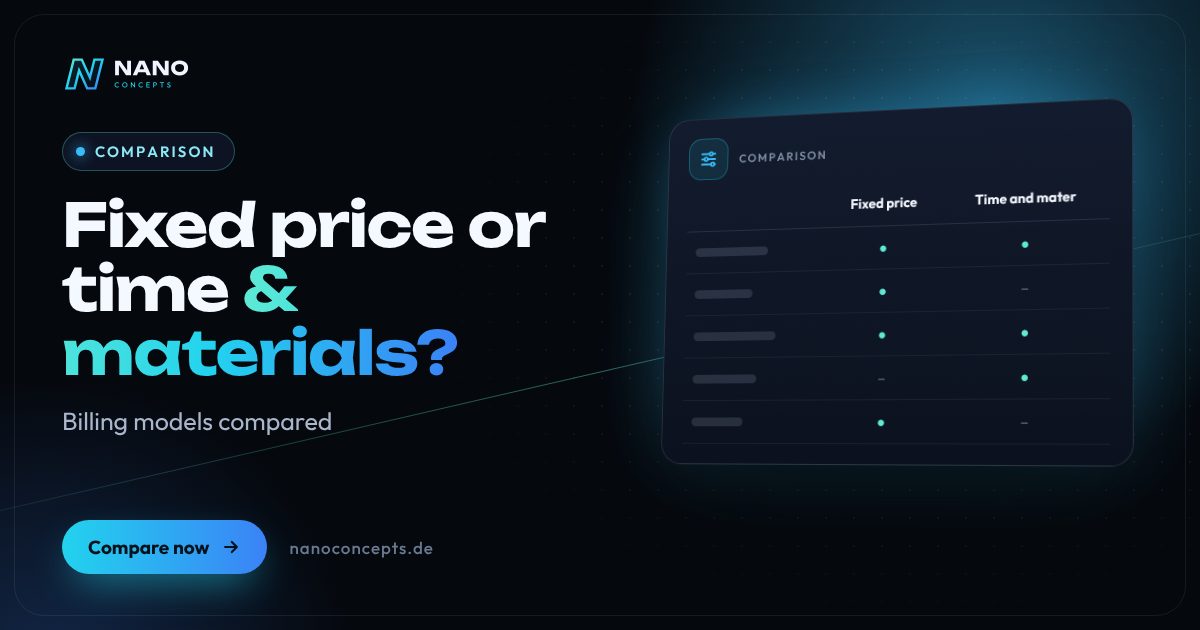
A fixed price fits when scope and requirements are clearly described before the project starts – you get budget certainty, and changes are handled through change orders. Billing on a time-and-materials basis (T&M) suits projects whose requirements only sharpen during development, such as MVPs, agile products or further development. Hybrid models have proven their worth: a fixed price for a clearly defined phase and time-and-materials billing with a budget cap for everything beyond that. For clearly defined scopes, Nano Concepts prefers to offer fixed prices.
Strengths and weaknesses at a glance
Fixed price
A fixed total price is agreed for a scope of services defined in advance. The basis is the most precise possible description of requirements, for example in a requirements specification (Lastenheft).
Strengths
- Budget certainty from the start
- Clearly defined deliverables and acceptance criteria
- Little management effort with stable requirements
- The service provider bears extra effort within the agreed scope
Weaknesses
- Detailed specification needed before the project starts
- Changes require change orders with a new calculation
- Service providers build a risk buffer into the price
Ideal for: Clearly defined projects such as websites, interfaces or apps with a stable, documented feature scope.
Time and materials (T&M)
The actual working time is billed at agreed rates, usually with regular reports. The scope can evolve during the project.
Strengths
- High flexibility when requirements change
- Quick project start without a complete specification
- Fits an agile approach in sprints with ongoing prioritization
- No risk premium – you pay the actual effort
Weaknesses
- Total cost is not fixed in advance
- Requires active management and prioritization on your side
- Transparent time tracking and trust are prerequisites
Ideal for: MVPs, product development, further development of existing software and projects with open requirements.
The most important criteria compared side by side
| Criterion | Fixed price | Time and materials (T&M) |
|---|---|---|
| Budget certainty | High | Low without a budget cap |
| Flexibility for changes | Low, changes via change orders | High, ongoing prioritization |
| Preparation | Detailed specification needed | Goals and a prioritized requirements list are enough |
| Project start | Later, after the specification | Fast |
| Risk of extra effort | With the service provider (within the agreed scope) | With the client |
| Management effort | Low with a stable scope | Higher, regular coordination |
| Suitable approach | Phase-oriented | Agile, e.g. with Scrum |
| Transparency | Via deliverables and milestones | Via time records and sprint results |
| Typical projects | Websites, clearly defined apps and interfaces | MVPs, product development, maintenance and expansion |
Fixed price or time and materials: who bears which risk?
With a fixed price, the service provider takes on the risk that the agreed scope takes more time than planned. In return, that scope must be described precisely in advance, and every change is calculated separately. With time-and-materials billing, you bear the volume risk: you pay for what is actually worked, and in return you can change course at any time, take on new ideas or drop features.
Neither model is cheaper per se. A reputable fixed price includes a buffer for uncertainties that you pay for even if everything runs smoothly. With time-and-materials billing, a project can turn out cheaper if you prioritize consistently – or more expensive if requirements keep growing. What matters, therefore, is how precisely you can describe your project today and how much is likely to change along the way.
Fixed price, firm price or lump sum: what is the difference?
In software projects, a fixed price (German: Festpreis) and a firm price (Fixpreis) usually mean the same thing: one fixed total price for a defined scope of services. The term lump-sum price (Pauschalpreis) is common mainly in construction, where it describes a flat amount for an overall service, while a “fixed price” there sometimes also means fixed unit prices, where the total depends on the quantity. So clarify in the quote exactly what the price covers.
Also to be distinguished is billing at an hourly rate, which at its core corresponds to the time-and-materials model: the time worked is compensated at agreed rates. In any case, make sure there is a clear description of services, comprehensible rules for changes and transparent reports. This explanation does not replace legal advice; for larger projects, having the contract reviewed by a lawyer is advisable.
Hybrid models: fixed-price phase, budget cap and agile fixed price
Combinations prove their worth in practice. A project often starts with a clearly delimited concept phase at a fixed price: requirements, prototype and effort estimate are developed together. After that, there is either enough clarity for a fixed price for the implementation, or development continues on a time-and-materials basis in sprints. This way you pay for planning certainty exactly where it is possible.
Another variant is time-and-materials billing with a budget cap, also called a cost ceiling: work proceeds flexibly, but an agreed sum is not exceeded without your approval. With an agile fixed price, budget and time frame are fixed, while the exact scope of features remains negotiable and is prioritized on an ongoing basis. Which variant fits depends on project size, uncertainty and the time you have for coordination.
How to recognize a fair quote
A good quote makes transparent what is included and what is not: features, design services, interfaces, testing, documentation, commissioning and training. With a fixed price, assumptions and exclusions should be stated explicitly; with a time-and-materials model, the rates, the way time is tracked and the reporting intervals. If this information is missing, misunderstandings are inevitable – regardless of the model chosen.
After the free initial consultation, Nano Concepts prepares a transparent quote, preferably as a fixed price for a clearly defined scope. Our packages serve as a guide: Starter from €2,500, Professional from €8,000 and Enterprise priced individually. If the scope is still open, we recommend a joint concept phase so that ideas turn into a reliable basis for the calculation.
Choose the fixed price if you can describe your requirements clearly and budget certainty matters more than flexibility – for example for a website, an interface or an app with a fixed feature scope. Opt for time-and-materials billing if your product only takes shape through user feedback or is continuously developed further. For many projects, a mix is ideal. For clearly defined scopes, Nano Concepts prefers to offer fixed prices and, for open-ended undertakings, honestly recommends a more flexible model with a clear budget limit.
We implement both approaches
Software Development
Software from requirements to operations – web, mobile and integrations from a single source.
Learn more
Custom Software
Software built around your workflows instead of standard tools with compromises – for replacing Excel, internal tools and specialized business applications.
Learn more
MVP Development
The first working version of your software or app – focused on the core features and quickly testable with real users.
Learn more
Technology Consulting
Software selection, architecture, code review and a digitalization roadmap – independent and implementation-oriented.
Learn moreFrequently asked questions
No. A reputable fixed price includes a risk buffer for uncertainties, which you pay even if everything goes smoothly. In return, you have budget certainty. With time-and-materials billing you pay only the actual effort, but you bear the risk that it turns out higher.
With a fixed price, one fixed total price is agreed for a scope defined in advance. With time and materials, the working time actually delivered is billed at agreed rates, and the scope may evolve. The fixed price offers planning certainty, time and materials more flexibility.
With an MVP, learning and fast adjustment are the priority, so billing on a time-and-materials basis with a clear budget cap usually fits. If the core scope of the MVP is already defined very precisely, a fixed price for the first version can also make sense. Further development after launch then often runs on a time-and-materials basis.
Changes and extensions that go beyond the agreed scope are described as a change order and calculated separately. You then decide whether the change is implemented, postponed or swapped for another feature. What matters is a simple process for such change requests, agreed in advance.
After the free initial consultation you receive a transparent quote, preferably as a fixed price for a clearly defined scope. Our packages serve as a guide: Starter from €2,500, Professional from €8,000 and Enterprise priced individually. We usually respond to inquiries within 24 hours.
More comparisons & guides
Custom software or SaaS – when does which solution pay off for your company?
Standard software as a service (SaaS) is the right choice if your process is common in your industry and a ready-made solution covers it well: fast start, low initial…
Learn more
Contract for work (Werkvertrag) or service contract (Dienstvertrag) in software development?
Under a contract for work (Werkvertrag, §§ 631 et seq.
Learn more
Cloud, SaaS or on-premise – where should your software run?
SaaS fits if mature off-the-shelf software exists for your process and you don't want any operating effort.
Learn more
How much does it cost to have software developed?
The cost of software development depends on the feature scope, the number of user roles, integrations with existing systems, security and data protection requirements,…
Learn more
How is software depreciated in Germany – and does a one-year useful life apply?
For tax purposes, the BMF circular (issued by the German Federal Ministry of Finance) on the useful life of computer hardware and software allows software to be…
Learn more
How much does a programmer cost per hour?
What a programmer costs per hour depends on experience, specialization, form of employment and billing model – a flat hourly rate says little without the scope of work.
Learn moreNeeds analysis: Fixed price or time & materials?
Answer a few short questions – we usually get back to you within 24 hours with an initial assessment.
Request a project
