
How is software depreciated in Germany – and does a one-year useful life apply?
Whether it is a purchased license, commissioned custom software or a monthly cloud subscription, software is treated very differently for tax purposes. Here you will learn the basic principles – and which questions to clarify with your tax advisor before you invest.
For tax purposes, the BMF circular (issued by the German Federal Ministry of Finance) on the useful life of computer hardware and software allows software to be depreciated over a useful life of one year for fiscal years ending after December 31, 2020 – an option, not an obligation. Under commercial law (HGB), this simplification does not apply automatically; what counts there is the expected actual useful life. Ongoing fees for cloud and SaaS services are not depreciated but booked as current expenses. This guide gives a general overview and does not replace tax advice.
Software depreciation: the one-year rule in German tax law
With its BMF circular (issued by the Federal Ministry of Finance) on the “useful life of computer hardware and software for data entry and processing,” Germany's tax authorities introduced a significant simplification: for fiscal years ending after December 31, 2020, the customary useful life of such software can be assumed to be one year. The original circular from 2021 was replaced in 2022 by a revised version that keeps the principle and clarifies the details.
It is not just classic office software that is covered. Operating and user software such as ERP systems, inventory management systems and other applications for business administration or process control are expressly named as well. Important: this is an option. You can use the one-year useful life, but you do not have to – for example, if spreading the cost over several years fits your profit planning better.
If you are searching for “software depreciation 2025” or “software depreciation 2026”: to the best of our knowledge (as of October 2026), the rule still applies. Before any larger investment, however, check whether new administrative guidance or changes in the law have been issued. Your tax advisor knows the current status and can apply it to your situation. For larger amounts in particular, this quick check is worthwhile.
Depreciating software under tax law and commercial law
The one-year rule concerns the determination of taxable profit. It does not apply automatically in the commercial balance sheet under the German Commercial Code (HGB): there, software that is part of fixed assets is depreciated systematically over the years in which it is expected to actually be used. For an ERP system or industry-specific software that stays in use for many years, this useful life can be significantly longer than one year.
For companies that prepare a balance sheet, this means that the commercial and tax balance sheets can diverge. That is permitted, but it creates reconciliation work and, for certain companies, can affect deferred taxes. Anyone who prepares a cash-basis income statement (Einnahmen-Überschuss-Rechnung) is generally not affected by this duplication, but must likewise distinguish cleanly between acquisitions and current expenses. There, too, the one-year rule is available as an option.
- Tax law: one-year useful life available as an option
- Commercial law: depreciation over the expected useful life
- Self-created software: option to capitalize under HGB, capitalization prohibited for tax purposes
- Cloud and SaaS fees: current expense, no depreciation
Purchased, commissioned or self-developed – what makes the difference
Purchased standard software with a perpetual license is a classic case of acquisition. Self-created software is different: for tax purposes, intangible fixed assets that were not acquired for consideration may not be capitalized, so development costs generally take effect immediately as a business expense. Under commercial law, by contrast, there is an option to capitalize internally generated intangible assets, subject to a restriction on distributions.
It gets more demanding with custom software that you commission from an agency. Whether it counts as acquired or self-produced depends, among other things, on who bears the economic risk of the development – for example, whether there is a contract for work (Werkvertrag) with an agreed result or billing on a time-and-effort basis. Your tax advisor should review this classification, ideally before the contract is signed.
As a software agency, we support this with a transparent breakdown: on request, we list concept, development, data migration, training and ongoing maintenance separately in the quote. That makes it easier for your tax firm to decide which item counts toward acquisition or production costs and which is booked as a current expense. At the same time, you keep track yourself of which portion is one-time and which is recurring.
Booking cloud costs: SKR03 and current expenses
With software as a service, you do not acquire a perpetual license; you pay for time-limited use. Such fees are therefore not depreciated but recorded as a business expense in the period concerned. For companies that prepare a balance sheet, annual subscriptions that extend beyond the balance sheet date may require a prepaid expense deferral so that the expense lands in the correct fiscal year.
If you search for “how to book cloud costs SKR03,” you will find different account suggestions in the SKR03, a standard chart of accounts widely used in Germany. In practice, SaaS fees are often booked to accounts for the time-limited transfer of rights such as licenses (SKR03 4964) or for maintenance costs of hardware and software (SKR03 4806), while permanently acquired software that counts as fixed assets goes to an account such as EDV software (SKR03 0027). The binding assignment is determined by your tax firm – what matters is consistent handling.
Booking Shopify costs: separating subscription, apps and fees
An online store on Shopify typically generates several types of costs: the monthly or annual plan fee, costs for apps and themes, payment and transaction fees, and possibly domain costs. For the search “how to book Shopify costs SKR03,” the principle is: plan and app fees are ongoing usage charges, while payment fees are often recorded as ancillary costs of payment transactions. It is important not to collect the different items in a single account.
Then there is value-added tax (VAT): if the provider of a service is based abroad, the reverse-charge mechanism can apply to services supplied to businesses – you then owe the VAT yourself and can deduct it as input VAT under the usual conditions. A theme purchased once may have to be treated differently from a subscription. That is why you should have your tax firm review the receipts regularly.
What depreciation means for your software investment
Tax rules should not be the sole factor in deciding between buying, subscribing and custom development. More important questions are: does the software fit your processes, how long do you want to use it, and what ongoing costs arise for operation, maintenance and further development? Depreciation mainly affects when the expense hits your profit – not whether the investment is worthwhile.
At Nano Concepts, we advise on software selection and develop custom software when standard solutions do not fit. For orientation: Starter projects start at €2,500, Professional projects from €8,000, and we calculate Enterprise projects individually. You will receive the exact quote after the free initial consultation – on request with a breakdown your tax advisor can use directly.
Note: This guide gives a general overview of principles as of October 2026 and does not replace tax advice. For your specific situation – legal form, method of profit determination, contract structure and size of the investment – please contact your tax advisor before you make any decisions. That is also where you will get a binding assessment of the useful life.
What to look out for
Type of acquisition
A perpetual license, a time-limited subscription and in-house development are treated differently for tax purposes – that is the first fork in the road.
Method of profit determination
Companies that prepare a balance sheet must consider both the commercial and the tax balance sheet; with a cash-basis income statement (Einnahmen-Überschuss-Rechnung), this duplication does not apply.
Contract structure for custom software
Who bears the production risk can determine whether the software is classified as acquired or self-produced.
Expected useful life
Decisive under commercial law: how long will the software realistically be used in the company?
Timing of acquisition
The purchase or completion date and the fiscal year determine in which year the expense takes effect.
Provider's location
With foreign providers, the reverse-charge mechanism can change the VAT treatment.
Separate ancillary services
Setup, data migration, training and maintenance should be itemized separately so that they can be assigned correctly.
Your take-away checklist
- Record the type of acquisition: purchase, subscription or custom development
- Request an invoice with separate line items for license, setup, training and maintenance
- Clarify with your tax advisor whether to use the one-year useful life
- If you prepare a balance sheet, document the useful life under commercial law
- Have contracts for custom software reviewed for tax implications before signing
- Check annual subscriptions that span the balance sheet date for a prepaid expense deferral
- Check invoices from foreign providers for a reverse-charge notice
- Define consistent accounts for cloud, SaaS and shop costs
How we support you
Custom Software
Software built around your workflows instead of standard tools with compromises – for replacing Excel, internal tools and specialized business applications.
Learn more
Software Selection Consulting
Criteria catalog, weighted scoring and hands-on tests: we guide your software selection, vendor-neutral, through to the decision.
Learn more
Software Development
Software from requirements to operations – web, mobile and integrations from a single source.
Learn moreFrequently asked questions
For tax purposes, this is generally possible through the one-year useful life under the BMF circular; according to the tax authorities, it is not objected to if the depreciation is taken in full in the year of acquisition. It is an option. Whether it makes sense for you depends on your profit situation – your tax advisor can clarify that.
No, not automatically. In the commercial balance sheet, software that is part of fixed assets is depreciated over its expected actual useful life. As a result, the commercial and tax balance sheets can differ from each other.
For tax purposes, a useful life of one year can still be applied under the BMF circular; to the best of our knowledge, this also applies to 2025 and 2026. Alternatively, a longer useful life is possible. Before larger investments, check with your tax advisor whether the administrative position has changed.
No. Subscription fees for SaaS or cloud services are payment for time-limited use and are booked as current expenses. For prepayments extending beyond the balance sheet date, a prepaid expense deferral may be necessary.
In practice, cloud and SaaS fees are often booked to accounts such as 4964 (time-limited transfer of rights) or 4806 (maintenance costs for hardware and software). Which account your tax firm uses may differ. What matters is a consistent assignment across all receipts.
That depends on the contract structure, in particular on who bears the production risk. Depending on that, the software counts as acquired and is depreciated, or as self-produced, which can mean a prohibition on capitalization for tax purposes. Have your tax advisor review the contract in advance; we itemize our services transparently for this purpose.
More guides & comparisons
How much does a programmer cost per hour?
What a programmer costs per hour depends on experience, specialization, form of employment and billing model – a flat hourly rate says little without the scope of work.
Learn more
How much does an ERP system cost?
What an ERP system costs depends on the license model (purchase or subscription per user), the number of users and modules, the need for customization, data migration,…
Learn more
How much does a CRM system cost?
What a CRM system costs depends mainly on the number of users, the feature set, and the effort for implementation, data migration and integrations.
Learn more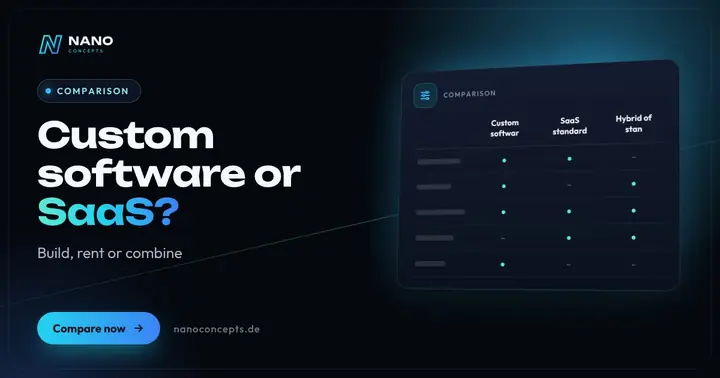
Custom software or SaaS – when does which solution pay off for your company?
Standard software as a service (SaaS) is the right choice if your process is common in your industry and a ready-made solution covers it well: fast start, low initial…
Learn more
Fixed price or time and materials – which is better for software projects?
A fixed price fits when scope and requirements are clearly described before the project starts – you get budget certainty, and changes are handled through change orders.
Learn more
Cloud, SaaS or on-premise – where should your software run?
SaaS fits if mature off-the-shelf software exists for your process and you don't want any operating effort.
Learn moreNeeds analysis: Depreciating software
Answer a few short questions – we usually get back to you within 24 hours with an initial assessment.
Request a project
