
Do I need my own website?
Many businesses are well booked and rightly ask why they need a website. Here you will find the honest trade-off – including the cases where a simple solution is entirely sufficient.
For most businesses, self-employed professionals and practices, the answer is yes: your own website is the only online presence whose content, address and rules you control entirely. Social media profiles, business directories and the Google Business Profile complement it but do not replace it, because the platforms control reach and presentation. Whether a small one-pager is enough or you need more depends on what your website is supposed to achieve.
Do I need a website if I use social media?
Instagram, Facebook or LinkedIn are good channels for reaching people. But the profiles do not belong to you: the platform decides who sees your posts, can change features and, if in doubt, can suspend an account. Anyone who builds their entire online presence on someone else's channel becomes dependent – and does not reach people who have no account there at all.
On top of that, people looking for a provider often start with Google. There, websites with service pages, opening hours and ways to get in touch appear. A website bundles everything a prospect needs to make a decision and links to your profiles. Social media generates attention, the website turns it into inquiries – the two work best together.
When your own website is worth it
A website is worth it whenever people want to find you, vet you or contact you. The trade business looking for skilled workers, the practice that wants to schedule appointments online, the service provider whose customers want to see references before inquiring: in all these cases, the website works for you around the clock – even when the phone is not staffed.
The website also plays a role in credibility. Many prospects google a provider before they call – even when they come via a referral. If all they find is an outdated business directory listing, it quickly looks less professional than the competitor with an up-to-date website. A solid presence is therefore often also a question of trust.
- Win new customers via Google
- Convince job applicants
- Accept inquiries, appointments or orders online
- Showcase services and references
- Take pressure off the phone and back office
When a simple solution is enough
Not every business needs an extensive website. If you are booked out for months, mainly look after regular customers and are not recruiting staff, a compact one-pager with services, contact details and legal texts can be entirely sufficient. What matters is that it is up to date, easy to read on a smartphone and technically clean – in this case, nothing more is needed.
For a single campaign, product or event, a landing page can also be the right way to go: one page with a clear goal, such as a sign-up or an inquiry. A website can always grow later. Anyone who starts small and builds cleanly saves themselves a complete rebuild when the business grows.
What does a website need to do to be worth it?
A website is only worth it if it fulfills a goal. For most businesses that means: visitors immediately understand what you offer and for whom, quickly find the path to an inquiry and trust you enough to get in touch. That takes clear copy, a good presentation on smartphones, short load times and clearly visible ways to make contact.
Beyond that, the website should be findable on Google and legally sound in Germany – with a legal notice (Impressum), a privacy policy and correctly integrated cookies. We describe what makes a good website in detail in the guide “What does a good website need to have?” For your decision, what counts most: better a few pages that convince than many that nobody reads.
What does a website cost per month – and is it possible without monthly costs?
No website reachable under its own domain is entirely free of ongoing costs. At a minimum, domain and hosting cost money regularly; depending on the solution, maintenance, updates, security and possibly licenses come on top. Free site builders do exist, but they often show ads, use an address belonging to the provider or restrict features and settings.
You can still save: a lean, technically clean website with few extensions causes less maintenance effort than an overloaded site with many plugins. We describe which monthly items apply in detail in the guide “How much does a website cost per month?” For the build, our packages offer guidance: Starter from €2,500, Professional from €8,000, Enterprise priced individually.
Google Business Profile, business directory, website: what do you really need?
The Google Business Profile is a must for local businesses: it shows address, opening hours and reviews directly in search and on Google Maps. Business directories and review portals additionally strengthen findability. Ideally, all these listings point to a website where prospects can learn more about your services and get in touch directly.
The best combination for most businesses: your own website as the hub, a maintained business profile for local search and one or two social media channels that fit your target audience. Together with our partner agency LOMA DESIGN, we can take care of everything from a single source if you wish – from the website to online marketing and social media.
These criteria help you decide
Are people searching for you online?
If customers search for your service on Google, inquiries go to competitors if you have no website.
Are you hiring?
Job applicants usually look for information online before applying – a careers page gives you an advantage.
How much explanation does your offering need?
The more questions customers have before buying, the more a website with service pages and an FAQ helps.
How important is trust?
References, real photos and named contact persons convince prospects who do not know you yet.
Do you want to digitize processes?
Appointment booking, inquiry forms or downloads save phone time and follow-up questions.
How independent do you want to be?
Your own website belongs to you – platforms can change rules, reach and features at any time.
Your take-away checklist
- Website goal defined (inquiries, applications, sales)
- Checked what your customers search for on Google
- Decided: one-pager, landing page or multi-page website
- Checked availability of your preferred domain
- Planned for ongoing costs for domain, hosting and maintenance
- Google Business Profile created or updated
- Services, photos and references collected
How we support you
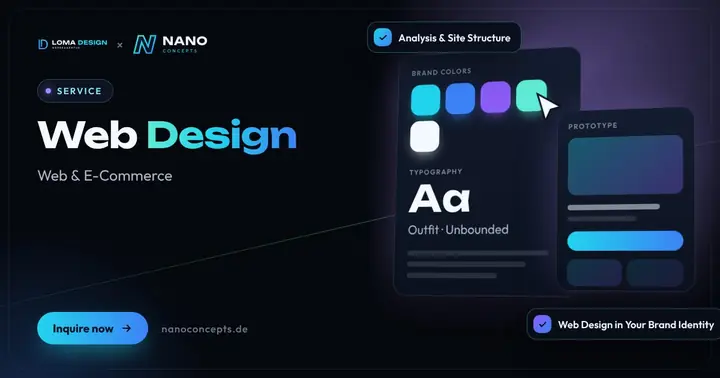
Web Design
Websites that show your brand clearly and guide visitors straight to an inquiry – designed with LOMA DESIGN.
Learn more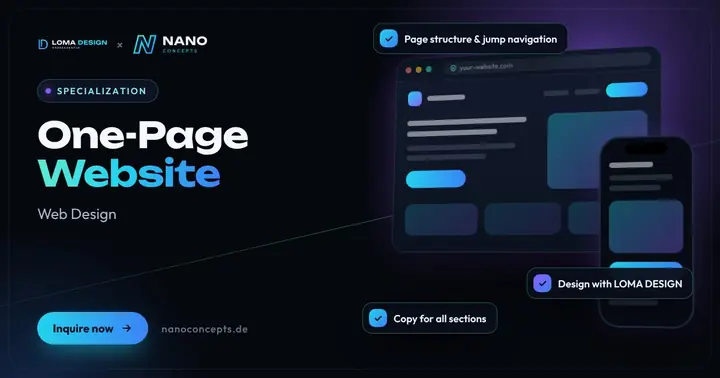
One-Page Website
One-page websites for freelancers and small businesses – a compact presence on a single page, mobile-optimized and online fast.
Learn more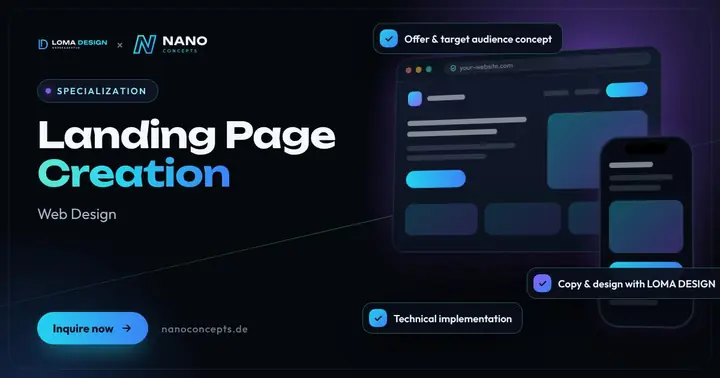
Landing Page Creation
Landing pages for ads and campaigns – one offer, one goal, measurable results. Concept and design with LOMA DESIGN.
Learn moreFrequently asked questions
In most cases yes, because customers search for and vet providers online. It does not have to be a big website, though: a compact one-pager with services, contact details and legal texts is enough for many small businesses. What matters is that it is up to date and works well on a smartphone.
Yes, because social media profiles belong to the platform, which controls reach and rules. The website is your own channel, which gets found on Google and turns prospects into inquiries. The two complement each other well.
It should clearly show what you offer, work well on smartphones, load quickly and offer simple ways to get in touch. Add to that a legal notice (Impressum), a privacy policy and a clean technical foundation for Google. Everything else depends on your goals.
At a minimum, domain and hosting are ongoing costs, depending on the solution also maintenance, updates, security and licenses. The amount depends heavily on technology and scope, which is why we do not quote flat figures. You will receive an itemized breakdown with our quote after the free initial consultation.
A website with its own domain always causes ongoing costs, at least for domain and hosting. Free site builders mostly use an address belonging to the provider, show ads or restrict features. For a business, that is rarely the right calling card.
The business profile is important for local search but offers only limited space for services, references and explanations. Google also controls how it is displayed. The strongest combination is a maintained profile plus your own website.
More guides & comparisons
How much does a landing page cost?
What a landing page costs depends mainly on concept, copy, design, form and tracking integration and maintenance effort – not on the number of pages.
Learn more
How much does a website cost – and what does the price depend on?
What a website costs depends mainly on scope, design ambition, content, features such as appointment booking or a shop, and the technical system.
Learn more
How long does it take to build a website?
How long it takes to build a website depends mainly on scope, features and how quickly texts, images and approvals are ready.
Learn more
Landing page or website – what do you really need?
Landing page or website?
Learn more
One-page or multi-page website – which suits your company better?
A one-page website bundles all content on a single scrollable page and fits when your offering is manageable, you have one clear message with one goal and want a fast,…
Learn more
SEO or Google Ads – which brings your company more inquiries?
Google Ads delivers visibility immediately and is easy to control, but it ends as soon as you stop the budget.
Learn moreNeeds analysis: Do I need a website?
Answer a few short questions – we usually get back to you within 24 hours with an initial assessment.
Request a project
