
Landing page or website – what do you really need?
“Website or landing page?” – the answer depends on where your visitors come from and what they should do. We show the differences and typical use cases from everyday business.
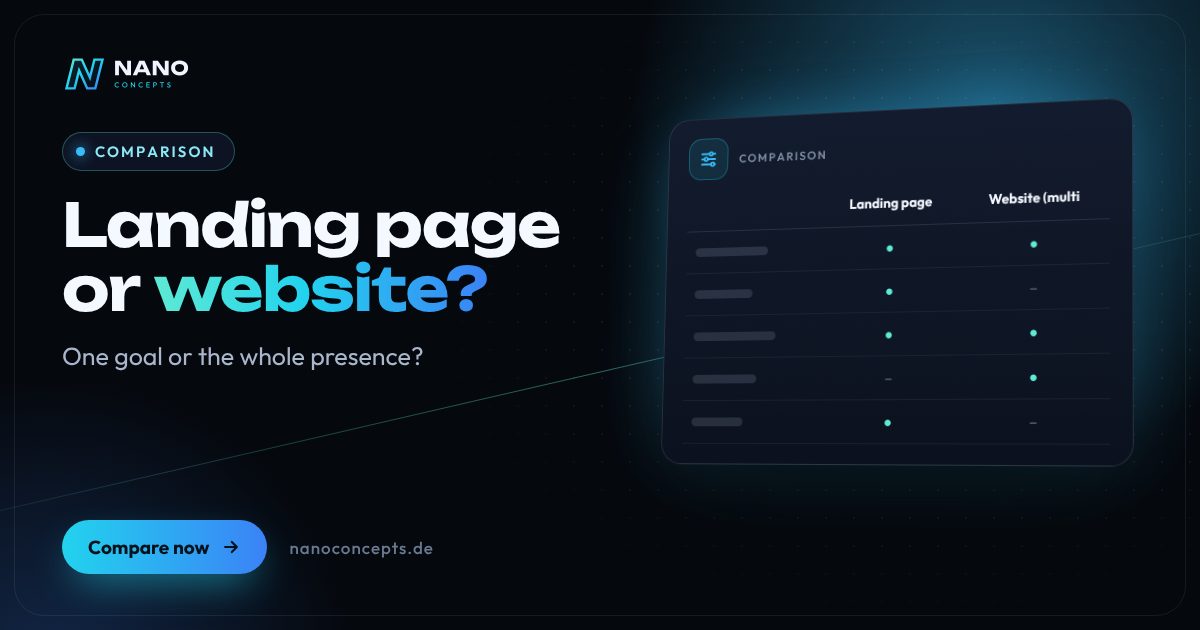
Landing page or website? A landing page is a single page with exactly one goal – such as winning inquiries from a Google Ads campaign – and deliberately leaves out distractions like the main navigation. A website presents your company comprehensively, is found through many search terms and builds trust through services, case studies and team. For campaigns, product launches and recruiting drives, the landing page is ideal; as a lasting basis for visibility, almost every company needs a website – the combination is usually the most effective.
Strengths and weaknesses at a glance
Landing page
A standalone page where visitors land after clicking an ad, a newsletter or a QR code. It pursues a single goal, such as an inquiry, booking or sign-up.
Strengths
- A clear message and a single call to action – fewer distractions for visitors.
- Ideal for paid campaigns: ad copy and page content match exactly.
- Quick to implement and good for A/B tests of headlines, offers and forms.
- Success is clearly measurable, for example through inquiries per campaign.
Weaknesses
- Usually ranks organically for only a few closely related search terms.
- Little room for comprehensive trust-building through case studies, team and company history.
- Not sufficient for lasting visibility and multiple target groups.
Ideal for: Advertising campaigns, product launches, events, recruiting drives and lead magnets.
Website (multi-page)
A presence with several pages for services, case studies, company, contact and often a blog or guide. It is the central digital address of your company.
Strengths
- Visibility on Google and in AI search for many services, locations and questions.
- Builds trust through case studies, team, processes and expert content.
- Addresses different target groups – customers, applicants and partners.
- A foundation that keeps growing over time, on which landing pages and campaigns build.
Weaknesses
- More effort for concept, copy and maintenance.
- Many navigation options can distract campaign visitors from the actual goal.
- SEO success comes gradually, not overnight.
Ideal for: Every company that wants to be found permanently and build trust.
The most important criteria compared side by side
| Criterion | Landing page | Website (multi-page) |
|---|---|---|
| Goal | One specific call to action | Comprehensive company presence |
| Scope | One page | Multiple pages and sections |
| Navigation | Reduced or no main menu | Full navigation |
| Typical visitor source | Ads, email, social media, QR codes | Organic search, referrals, direct visits |
| SEO potential | Limited to one topic | High, for many search terms |
| Trust-building | Compact with targeted proof | Comprehensive with case studies, team and content |
| Implementation | Fast | More extensive |
| Measuring success | Very clear through conversions | Multifaceted across several goals |
| Mandatory information | Legal notice (Impressum) and privacy policy required | Legal notice (Impressum) and privacy policy required |
Landing page vs. website: the difference in one sentence
A website answers the question “Who are you and what do you offer?”, a landing page answers “What should I do now?” The website is broad, with a menu, service pages and contact. The landing page concentrates on one offer and leads visitors straight to an action, for example filling out a form or booking an appointment.
An everyday example: a skilled-trades business runs Google ads for bathroom renovation. If the ad leads to the homepage, prospects first have to click around. A matching landing page immediately shows services, process, sample projects and a short inquiry form. The website remains important all the same, because many prospects check who is behind the offer before they inquire.
Landing page or homepage: what's the difference?
The homepage is the start page of your website and thus the hub for all sections. A landing page, by contrast, is tailored to a specific entry point. Technically, any page on which visitors “land” can be called a landing page. In marketing, however, the term means a page with a single goal that fits a particular campaign.
On spelling: “landing page” and “landingpage” mean the same thing. English uses two words, while German often writes it as one. More important than the spelling is that your landing page, like any business page, links to a legal notice (Impressum) and a privacy policy, and that forms and tracking are set up in compliance with data protection. A missing legal notice can lead to a cease-and-desist warning (Abmahnung) – even on pure campaign pages.
When a landing page is enough – and when it isn't
A landing page alone can be enough if you are promoting a single offer for a limited time, testing a product idea or recruiting participants for an event. For founders who want to test demand first, it is also a fast and economical way in. For very small businesses with a clear range of services, a one-page website can also be a good start.
As soon as you offer several services, want to be found in several locations or are looking for skilled workers, a single page reaches its limits. Then you need a website with its own pages for each topic, which search engines and AI systems can clearly classify. Landing pages complement this foundation for campaigns without replacing the website. Applicants and business partners also expect information that goes beyond a single offer.
How landing page and website work together
In practice, the combination is the most successful. Through service pages, case studies and guides, the website builds organic visibility and trust. For each campaign, a dedicated landing page is created whose headline and offer match the ad exactly. Both share design, logo and tone, so that visitors instantly recognize the sender. Forms and contacts should also be consistent across both.
Clean measurement is important: with clearly defined conversions, you can see which campaign brings inquiries and which page should be optimized. Together with our partner agency LOMA DESIGN, we combine concept, design, copy and technical implementation so that website and landing pages work as one system. That way you invest your advertising budget where it demonstrably works.
If you want to win inquiries from a campaign in the short term or test an offer, a landing page is the fastest and most measurable solution. For lasting visibility, trust and multiple services, you need a website. Most companies do best with both: a solid website as the foundation and targeted landing pages for promotions. Nano Concepts advises you honestly on this – and will recommend a smaller solution even if it already achieves your goal.
We implement both approaches
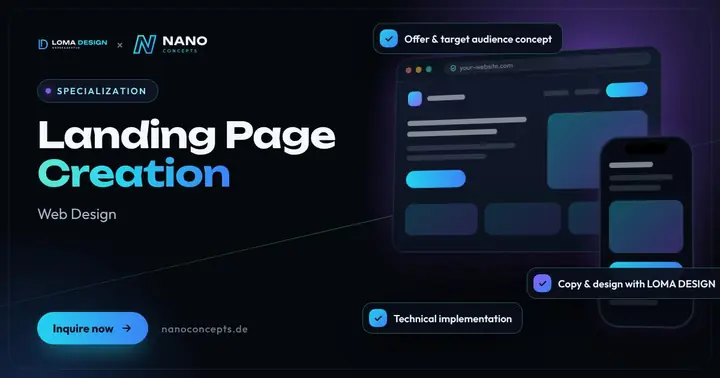
Landing Page Creation
Landing pages for ads and campaigns – one offer, one goal, measurable results. Concept and design with LOMA DESIGN.
Learn more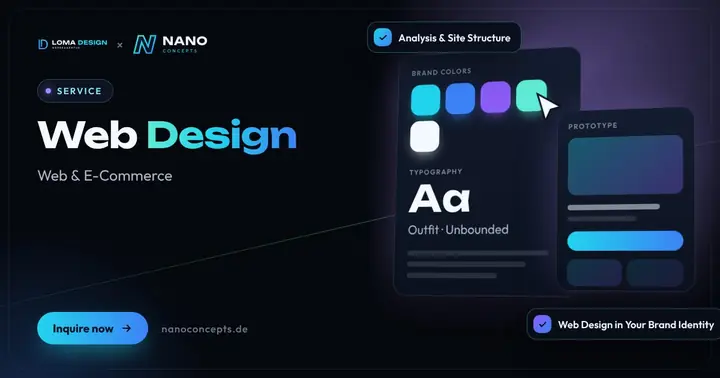
Web Design
Websites that show your brand clearly and guide visitors straight to an inquiry – designed with LOMA DESIGN.
Learn more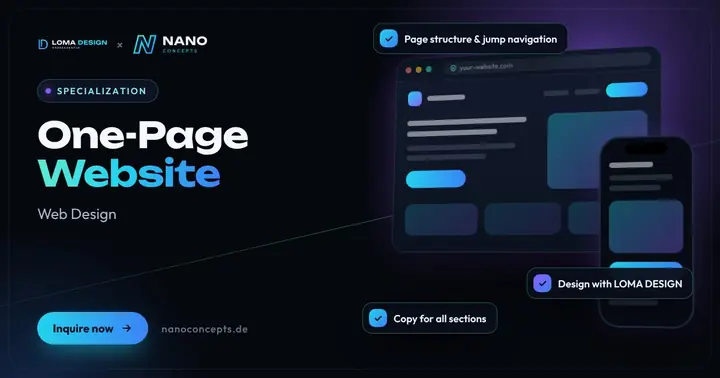
One-Page Website
One-page websites for freelancers and small businesses – a compact presence on a single page, mobile-optimized and online fast.
Learn moreFrequently asked questions
A landing page is a single page with one specific goal, usually for a campaign. A website comprises several pages and presents your company comprehensively with services, case studies and contact. A landing page can be part of the website or exist on its own.
For a time-limited campaign, a product test or a single offer, a landing page can be enough. If you want to be found permanently through Google and show several services, you need a website. Many companies start with a landing page and later build a website around it.
The homepage is the start page of your website and leads to all sections. A landing page is tailored to a specific entry point, such as an ad, and steers toward a single action. For campaigns, a matching landing page is therefore usually the better destination page than the homepage.
Yes. Even a single business landing page in Germany must provide an easily accessible legal notice (Impressum) under the German Digital Services Act (Digitale-Dienste-Gesetz, DDG) and a privacy policy. If forms, tracking or cookies are used, consent and privacy notices must also be observed. This note does not replace legal advice.
Because of its smaller scope, a landing page is usually faster and cheaper to build than a multi-page website. As a guide, our Starter package starts at €2,500; more extensive websites with many pages and features can fall under the Professional package from €8,000. You receive the exact quote after the free initial consultation.
More comparisons & guides
One-page or multi-page website – which suits your company better?
A one-page website bundles all content on a single scrollable page and fits when your offering is manageable, you have one clear message with one goal and want a fast,…
Learn more
SEO or Google Ads – which brings your company more inquiries?
Google Ads delivers visibility immediately and is easy to control, but it ends as soon as you stop the budget.
Learn more
WordPress or a website builder like Wix and Jimdo – which is the better fit?
A website builder like Wix or Jimdo is the right choice if you want to run a small website with only a few pages yourself, quickly and without technical effort – the…
Learn more
Do I need my own website?
For most businesses, self-employed professionals and practices, the answer is yes: your own website is the only online presence whose content, address and rules you…
Learn more
How much does a landing page cost?
What a landing page costs depends mainly on concept, copy, design, form and tracking integration and maintenance effort – not on the number of pages.
Learn more
How much does a website cost – and what does the price depend on?
What a website costs depends mainly on scope, design ambition, content, features such as appointment booking or a shop, and the technical system.
Learn moreNeeds analysis: Landing page or website?
Answer a few short questions – we usually get back to you within 24 hours with an initial assessment.
Request a project
