
One-page or multi-page website – which suits your company better?
Everything on one page or a clear structure with subpages – this shapes findability, usability and growth of your website. Here you can see how the two structures differ in practice.
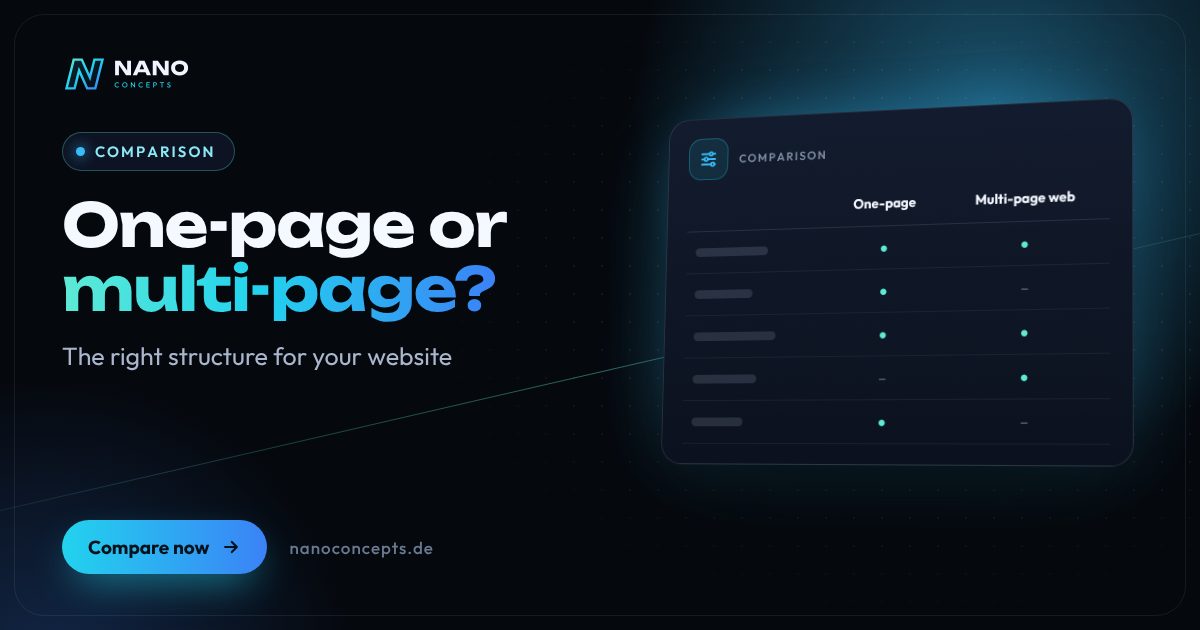
A one-page website bundles all content on a single scrollable page and fits when your offering is manageable, you have one clear message with one goal and want a fast, focused impact. A multi-page website is better as soon as you address several services, locations or target groups, want to cover many different search terms through search engines, or plan to keep expanding your content. For most companies, a multi-page structure is the more durable foundation.
Strengths and weaknesses at a glance
One-page
All content sits on a single page that visitors scroll through from top to bottom. The navigation jumps to sections within the page.
Strengths
- A clear, guided narrative with a common thread leading to the call to action
- Quickly grasped: visitors see everything essential without clicking
- Manageable scope in design, production and maintenance
- Works very well on smartphones
Weaknesses
- One address has to cover all topics, which makes targeting different search terms harder
- Growth quickly hits limits when services, locations or content are added
- Long pages can strain load time and overview if images and scripts are not optimized
Ideal for: Freelancers, events, product presentations, single offers and companies with a manageable range of services.
Multi-page website
Content is spread across separate pages, such as home, services, about us, references, guides and contact, connected through a menu.
Strengths
- Each page can address its own topic and its own search term
- Easily extended with new services, locations, guides or industries
- Visitors find what they are looking for; pages can be linked and shared individually
- Detailed analysis of which content works
Weaknesses
- More planning, copy and maintenance
- Without clear navigation and structure, visitors get lost
- More pages mean more responsibility for quality, currency and linking
Ideal for: Companies with several services, a regional focus, a need for advice, or the goal of growing continuously through search engines.
The most important criteria compared side by side
| Criterion | One-page | Multi-page website |
|---|---|---|
| Structure | One document with sections | Several pages with a menu structure |
| SEO potential | Concentrated on a few topics | High, many topics and search terms can be covered |
| Local visibility | Limited, one page for everything | Good with service and location pages |
| User guidance | Linear, clear path to action | Freely navigable, entry via any page |
| Extensibility | Quickly at its limit | Grows with the offering |
| Effort for planning & content | Manageable | Higher, but more durable |
| Mandatory pages (legal notice, privacy) | Usually separate subpages or overlays needed | A natural part of the structure |
| Analysis | Sections comparable only with additional tracking | Pages can be analyzed individually |
| Best suited for | Manageable offers, promotions, individuals | Companies with several services or locations |
One-page and SEO: where is the limit?
Search engines evaluate pages, not sections. A one-page site therefore has one topic and one address at its core. If you want to be found for “emergency heating service”, “bathroom renovation” and “heat pump” at the same time, you cannot serve these terms equally well on a single page without blurring the message. For the brand name, a specific place or a single offer, however, a well-made one-pager can certainly be found.
Technology and content count in addition: fast load time, clean heading structure, meaningful copy and images with alt texts. That applies to both structures. The difference: on multi-page websites each topic can be treated in the necessary depth and linked internally, whereas the one-pager becomes cluttered as it grows longer and individual sections hardly appear on their own in search results.
Mandatory information and legal pages on a one-pager
Even a one-pager needs a legal notice (Impressum) and a privacy policy that are easy to recognize and directly accessible. In practice, they usually sit on separate subpages or in overlays that can be reached from every section. Consents for cookies and embedded services also have to work cleanly. A one-pager is therefore rarely truly “one page”, but at its core a main page with legal subpages.
If your company offers consumers online booking or a store, for example, further obligations may apply, including accessibility under the German Accessibility Strengthening Act (BFSG), which has applied since June 28, 2025. You should check case by case whether and to what extent they affect your company – the same goes for price indications and consumer information. This does not replace legal advice.
Usability, load time and mobile devices
One advantage of the one-pager lies in usability: whoever scrolls does not have to decide where to click. On a smartphone this feels natural, and the message can be built dramatically – from the problem through the solution and the proof to the inquiry. With clear design, this creates strong attention as long as the scope stays manageable.
The downside: a long page loads all content, images and scripts at once or has to reload them cleverly. Without optimization, load time suffers, and visitors drop off, especially on mobile. Multi-page websites can be slow too – the difference is that on them each page only has to load what it needs. Image formats, fonts and scripts are decisive in both cases.
From one-pager to full website: how the presence grows with you
Many companies deliberately start small: a one-pager as a quick business card or a landing page for an offer. As the business grows, service pages, references, a guide section or locations are added. Plan for this from the start: choose a system that adds subpages easily, and keep the sections modular so that they can later become pages of their own.
When moving from the one-pager to a multi-page structure, keep existing addresses and rankings in view. Anchor links such as #services are generally not treated by search engines as separate pages; new subpages, by contrast, need a clean structure, internal linking and, where applicable, redirects. That way the starting point becomes a foundation.
Choose a one-pager if your offering is manageable, a clear message is front and center and the website is mainly meant to convince and lead to an inquiry – for example for freelancers, promotions or a single product. Choose a multi-page website if you have several services, locations or target groups and want to grow continuously through search engines. When in doubt, start modular. Nano Concepts builds both variants and plans the structure so that it can grow with you later.
We implement both approaches
One-Page Website
One-page websites for freelancers and small businesses – a compact presence on a single page, mobile-optimized and online fast.
Learn more
Web Design
Websites that show your brand clearly and guide visitors straight to an inquiry – designed with LOMA DESIGN.
Learn more
Technical SEO & Relaunch
Relaunch and technical SEO with a redirect plan, load-time optimization and monitoring – together with LOMA DESIGN.
Learn more
Landing Page Creation
Landing pages for ads and campaigns – one offer, one goal, measurable results. Concept and design with LOMA DESIGN.
Learn moreFrequently asked questions
Not inherently, but limited. A one-pager can be found well for the brand name, a place or a single offer. For many different search terms, services and locations, a multi-page website has the advantage, because each page can target its own topic.
Yes. Both must be easy to recognize and directly accessible, usually as a separate subpage or overlay. In addition, a working consent solution for cookies and embedded services is needed. This does not replace legal advice.
A one-pager is usually cheaper because there are fewer pages, less copy and less structural work. However, costs depend on design, features and content, not on the page count alone. As a guide: Starter from €2,500, Professional from €8,000, Enterprise on request.
At the latest when several services, locations or target groups are added, you want to be found for many search terms, or the page becomes too long and cluttered. A guide section or blog also speaks for a structure with subpages.
For a quick online presence with services, contact and references, it can be enough. If you want to be found regionally across several places and trades, dedicated service and location pages work better. What matters is how many topics your website is meant to carry.
More comparisons & guides
Landing page or website – what do you really need?
Landing page or website?
Learn more
SEO or Google Ads – which brings your company more inquiries?
Google Ads delivers visibility immediately and is easy to control, but it ends as soon as you stop the budget.
Learn more
WordPress or a website builder like Wix and Jimdo – which is the better fit?
A website builder like Wix or Jimdo is the right choice if you want to run a small website with only a few pages yourself, quickly and without technical effort – the…
Learn more
Do I need my own website?
For most businesses, self-employed professionals and practices, the answer is yes: your own website is the only online presence whose content, address and rules you…
Learn more
How much does a landing page cost?
What a landing page costs depends mainly on concept, copy, design, form and tracking integration and maintenance effort – not on the number of pages.
Learn more
How much does Google Ads management cost – and what does the price depend on?
With Google Ads you pay two separate items: the ad budget, which goes directly to Google and whose amount you set yourself, and the agency’s fee for setup, ongoing…
Learn moreNeeds analysis: One-page or multi-page?
Answer a few short questions – we usually get back to you within 24 hours with an initial assessment.
Request a project
