
How to find an app developer: what matters when choosing?
An app is a product that will accompany you for years – and the developer becomes a partner, not just a supplier. This guide helps you compare the options, ask the right questions and spot warning signs in time.
You find the right app developer by first describing your project briefly and then choosing based on experience with comparable apps, neutral technology advice, clear communication, a comprehensible quote and support after launch. Freelancers suit clearly defined tasks, agencies suit projects that cover concept, design, development and publishing, and an in-house development team only pays off with permanent demand. Clarify early who owns the source code, developer accounts and credentials. For orientation at Nano Concepts: Starter from €2,500, Professional from €8,000, Enterprise individual.
Clarify the project first, then look for the developer
Anyone who looks for an app developer without being able to describe the project receives quotes that can hardly be compared. So put down on one or two pages what the app should do: goal, target group, the most important functions, desired platforms, a rough timeframe and a budget range. Sketches or example apps that you like help more than long texts.
This brief does not have to be perfect. Good developers ask questions, sharpen the assumptions and point out which functions can be left out for the start. The asking itself is a first quality feature: anyone who answers every inquiry immediately with a fixed price, without questioning anything, has probably not yet engaged with your project.
Freelancer, agency or in-house team: the routes compared
A freelancer usually works directly with you, is flexible and is often a good choice for clearly defined tasks. The risk lies in depending on one person: if they drop out or are fully booked, the project stands still. Individuals also rarely cover everything an app needs – concept, design, mobile interface, server side, testing and publishing in the stores.
An agency brings a team, backups and project management, which makes concept, design and development from a single source possible. In return, the coordination share is visible in the price. An in-house development team pays off mainly when the app is your company’s core product and is developed continuously; salary, selection and management are then your job. For very simple cases, a website builder may also be enough.
- Freelancer: flexible and direct, but dependent on one person
- Agency: team, backup and project management, with coordination in the price
- In-house team: full control and know-how in the company, but setup and fixed costs
- Builder: fast and cheap for simple cases, with limits on functions and ownership
Native app, cross-platform or web app: the technology question made clear
A good developer explains the options instead of just selling their favorite technology. Native apps for iOS and Android, for example with Swift and Kotlin, offer the closest access to device functions but mean two separate developments. Cross-platform approaches such as React Native or Flutter share a large part of the code and often reduce the effort, with limitations for very special device functions.
A web app or Progressive Web App runs in the browser, can be placed on the home screen and needs no approval from the app stores. For many business applications that is enough. So ask specifically: why do you recommend this technology for my project, and what would speak against it? An honest answer names advantages and disadvantages, including those that speak against the developer’s own offer.
How to recognize a good app developer
References that you can check yourself are meaningful: download published apps from the stores and try them out. Ask what role the developer had specifically, which problems occurred and how they were solved. Pay attention to how clearly they explain, whether they ask follow-up questions and whether effort, risks and assumptions are described comprehensibly in the quote.
Further criteria are the handling of testing, security and data protection, experience with the stores’ review processes and a clear plan for the time after launch. Warning signs are blanket promises, a price without a description of services, pressure to sign quickly, unwillingness to show interim versions and refusal to give you access to code and accounts.
Contracts, rights and developer accounts: what to clarify in advance
Before the project starts, clarify in writing who owns the source code, design and content and which usage rights you receive. The developer accounts with Apple and Google should be registered to your company, not to the agency or the freelancer, otherwise publishing depends on third parties. Fees from the platform operators apply for these accounts. Agree that credentials and documentation are handed over.
Also regulate acceptance and warranty, the type of billing (fixed price or time and materials), maintenance after launch and a data processing agreement if personal data is processed. Apps need ongoing care because operating systems and store requirements change. For contract questions in an individual case, please turn to legal advice; this guide does not replace it.
How we work with you at Nano Concepts
After the free initial consultation you receive a transparent quote, preferably at a fixed price for a clearly defined scope. Implementation takes place in stages with visible interim versions, and the design is created together with our partner agency LOMA DESIGN. We support publishing in the stores and further development. We also advise on when a web app or a simpler solution is enough.
For orientation: the Starter package from €2,500 suits compact applications with a clear core, the Professional package from €8,000 suits apps with accounts, backend and integrations, and we quote large platforms individually as Enterprise projects. We work from Dudenhofen near Speyer for customers across Germany, remotely and on site where needed.
These criteria help you decide
Experience with comparable apps
Published reference apps that you can try yourself say more than any description.
Neutral technology advice
A good developer explains native, cross-platform and web solutions with advantages and disadvantages.
Communication and contact persons
Clear explanations, follow-up questions and fixed contacts show how collaboration will run later.
Comprehensible quote
Scope of services, assumptions, risks and type of billing should be described clearly.
Rights and access
Source code, developer accounts and credentials must be with you or handed over to you.
Support after launch
Updates for new operating system versions, bug fixing and further development belong to the overall picture.
Security and data protection
Handling of user data, encryption and data processing agreements need to be clarified from the start.
Backup and team size
Whether absences can be covered determines reliability on longer projects.
Your take-away checklist
- Describe the project on one or two pages: goal, target group, functions, platforms
- Record budget range and desired timeframe
- Compare three or four providers and give them the same materials
- Download and try the reference apps yourself
- Ask about the choice of technology, alternatives and risks
- Check quotes for scope, type of billing and support
- Clarify rights to source code and developer accounts by contract
- Agree on maintenance, updates and responsibility after launch
How we support you
Mobile Apps
Apps for iOS and Android – from concept and design through development to publishing in the stores.
Learn more
React Native Apps
React Native apps for iPhone and Android from one codebase – native feel, push, offline and store release included.
Learn more
Progressive Web Apps
Installable web apps with offline mode and push – one codebase for smartphone, tablet and desktop, no app store required.
Learn more
Technology Consulting
Software selection, architecture, code review and a digitalization roadmap – independent and implementation-oriented.
Learn moreFrequently asked questions
Good routes are recommendations from your network, agencies and freelancers with verifiable reference apps, and regional providers you can talk to in person. The place you find them matters less than the check: look at references, ask questions and compare quotes.
A freelancer suits clearly defined tasks and smaller projects, an agency suits projects that need concept, design, development, publishing and support. In both cases, ask about backup, rights and support after launch.
Download the apps mentioned yourself and check usability and stability. Ask what role the developer had in the project and which problems had to be solved. Be careful with references that cannot be verified.
Why do you recommend this technology? How does the project run and when do I see interim versions? How do you handle change requests? Who owns code and accounts? What happens after publication? The answers quickly show how transparent and reliable someone works.
That depends on the contractual arrangement and should be fixed in writing before the project starts, including the usage rights to source code and design. The developer accounts should also be registered to your company. We discuss this in the initial consultation and record it in the quote.
The costs depend on scope, platforms, functions and integrations. At Nano Concepts, apps and web applications start in the Starter package from €2,500, more extensive solutions in the Professional package from €8,000. The exact quote follows the free initial consultation.
More guides & comparisons
How much does it cost to publish an app on the App Store and Play Store?
To publish on the Apple App Store, you need a membership in the Apple Developer Program for $99 per year; for the Google Play Store, you pay a one-time $25 for the…
Learn more
How much does a web app cost – and what drives the price?
What a web app costs depends mainly on its scope of features, user roles, data model, integrations with other systems, design ambition and ongoing operation.
Learn more
How do you introduce AI in a company?
The best way to introduce AI in a company is step by step: select specific use cases with a visible benefit, review the data situation and data protection, define tools…
Learn more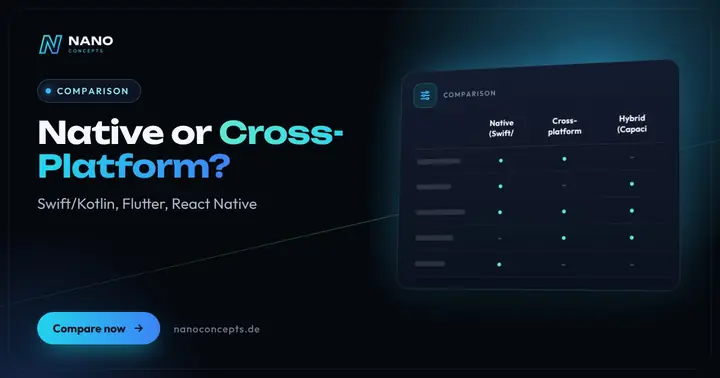
Native or cross-platform app: Swift and Kotlin, Flutter, React Native or hybrid?
Cross-platform with Flutter or React Native is the most economical route for most business and consumer apps today, because a shared codebase serves iOS and Android in…
Learn more
Flutter or React Native – which framework is right for your app?
Both frameworks are mature and deliver apps for iOS and Android from a single codebase in near-native quality.
Learn more
Native app or progressive web app (PWA) – which is better?
A PWA is enough if your app mainly handles content, forms, bookings or orders, should work without an app store and needs to be available quickly on all devices.
Learn moreNeeds analysis: Find an app developer
Answer a few short questions – we usually get back to you within 24 hours with an initial assessment.
Request a project
