
Entrepreneur Game: A Business Simulation for Founders and Entrepreneurs
Invest, hire, market – without real risk: the Entrepreneur Game is a realistic simulation game for founders and entrepreneurs in the making. A project by three partners – and a look at what you can learn from it for your own gamification projects.
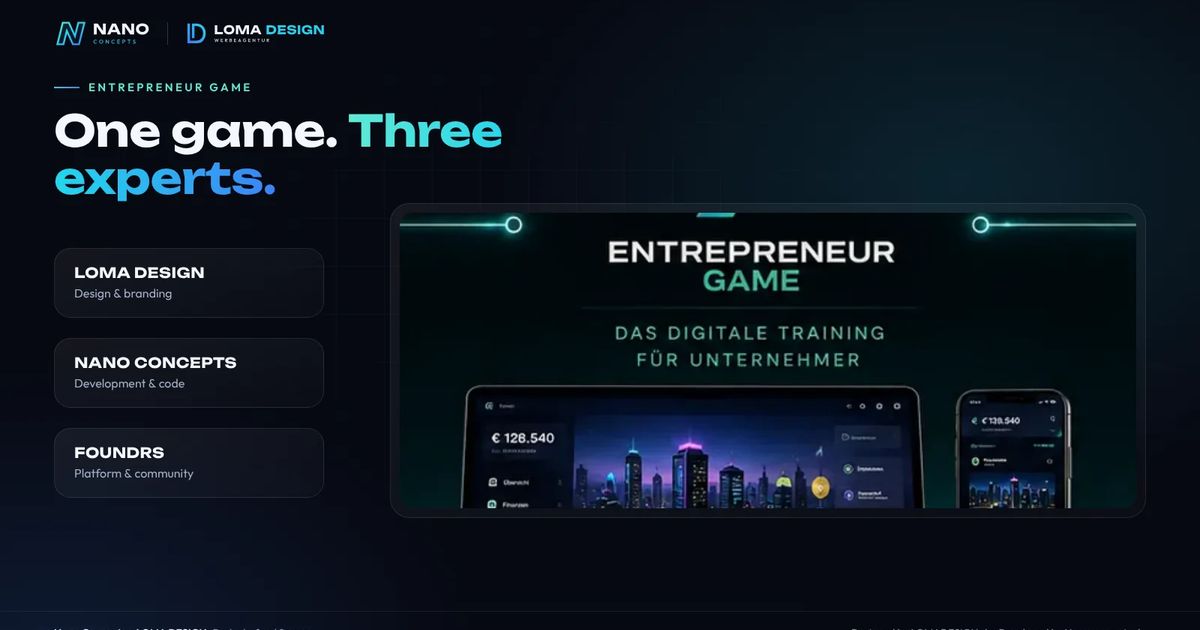
The Entrepreneur Game is a realistic online simulation game for entrepreneurs, founders and anyone who wants to become one. Players start their own business, make decisions on investments, marketing and staff, and see in every round which strategy works – without real risk. Three partners from our network are developing it together: LOMA DESIGN, Nano Concepts and FOUNDRS.
Instead of textbook theory, your own decision takes center stage – with all its consequences. In this article we present the idea, show who the game is for and explain what lies behind such a project in terms of design and technology. We also show what you can take from it for your own learning and gamification projects.
Learn. Decide. Simulate success.
Players start their own business and make the decisions that count in real life as well: investments, marketing, staff. Every choice has consequences – and every round shows which strategy works.
- Real decisions instead of dry theory
- Realistic simulation
- Learning by experience – without risk
- For founders, students, employees and entrepreneurs
Why a business simulation?
Entrepreneurial thinking is best learned by doing. But in real life every mistake is expensive: an investment made too early, a wrong hiring decision or a marketing budget without effect can seriously endanger a young company.
A simulation creates a protected space. Players can try out strategies, make mistakes and learn from them – and take a different path on the next run. Relationships that remain abstract in theory become tangible: What happens to liquidity if I grow too fast? Is the additional specialist worth it, or will the money then be missing in marketing?
Questions a simulation makes tangible
At its core, entrepreneurship is about trade-offs. A good simulation makes these trade-offs tangible because every answer has consequences:
- Do I invest in growth now or build up reserves first?
- Do I hire another person or does the team stay small for now?
- Do I rely on a lot of marketing or on a better offering?
- How do I react when the market develops differently than planned?
There is rarely one right answer. That is precisely what creates the learning effect: players experience that a strategy has to fit the respective point in time and the respective situation.
The three pillars of the game
Investing
Where does the capital go – into equipment, offering or growth? Investment decisions often take effect only with a delay, just as in a real company. Those who plan ahead have an advantage. And sometimes the best investment is the one you deliberately do not make.
Hiring
A company is only as strong as its team. When is the right time for the first hire, and which role moves the business forward the most? Staffing decisions are among the questions that occupy founders most in everyday life.
Marketing
The best offering is of no use if nobody knows about it. Marketing decisions determine how quickly a company wins customers – and how much it spends on doing so.
Who the Entrepreneur Game is for
- Founders and aspiring founders who want to play through business decisions before launching
- Students who want to apply business knowledge in practice
- Employees who want to understand how decisions in a company are connected
- Entrepreneurs who want to question strategies in a playful way and sharpen their thinking
Entrepreneurial thinking is not only important for founders. Employees, too, make decisions every day that affect costs, customers and colleagues. Anyone who understands how a company works as a whole can justify proposals better, understand priorities and take on responsibility. This is exactly the understanding the Entrepreneur Game aims to foster – without jargon and without a wagging finger.
What players take away
In the end, it is not about high scores but about a better feel for how business relationships work. Anyone who has played several rounds understands why liquidity is often more important than revenue, why growth needs to be planned and why every decision ties up resources that are missing elsewhere. This knowledge can be transferred to real situations – from the business plan to the next investment decision.
One game. Three experts.
The project brings together three partners from our network. FOUNDRS contributes not only the technical platform but also a community of founders and entrepreneurs – in other words, exactly the people the game is meant for.
| Partner | Responsibility in the project |
|---|---|
| LOMA DESIGN | Design and branding |
| Nano Concepts | Development and technical architecture |
| FOUNDRS | Platform, hosting and community |
This division follows a principle that we also live by in client projects: each partner contributes their strength, and everyone works as one team. Brand, interface and game logic are not created one after another but in constant exchange. Why this makes sense is described in the article Design meets development.
What lies behind a simulation
A simulation game is more demanding than it appears at first glance. Every decision needs comprehensible consequences, the values must be balanced, and the interface has to make complex relationships understandable. In addition, there must be a platform that runs reliably even when many people play at the same time.
For Nano Concepts, the Entrepreneur Game is therefore also a showcase: the experience in game logic, data models and platform operation feeds directly into web applications for our clients – for example learning platforms, configurators or interactive calculators. LOMA DESIGN’s know-how shows in a design that makes even complex content easy to access; more on this on our UI/UX design page.
General principles of good learning simulations
Regardless of the specific game, a few principles have proven themselves for learning and decision simulations:
- Comprehensible cause and effect: Players must be able to understand why something happened – otherwise they learn nothing.
- Make delayed effects visible: Many business decisions take effect only later; the interface should keep the connection recognizable.
- Balanced values: Neither a single all-purpose strategy nor pure chance should determine the outcome.
- Immediate feedback: After every round, players see what their decision has achieved.
- Repeatability: A second run with a different strategy is part of learning.
- Debriefing: In training and seminars, evaluating the decisions together consolidates what has been learned.
Gamification in your own project: how to get started
Work on the Entrepreneur Game confirms what also applies to client projects: an interdisciplinary team works faster than a chain of individual service providers. Early prototypes show whether an idea holds up before a lot of budget is spent. And nothing replaces testing with real users – especially when it comes to whether relationships are presented in an understandable and motivating way.
Gamification is by no means just for games. Progress indicators, challenges and immediate feedback also make training, onboarding processes or customer portals more motivating:
| Area of use | Possible elements | Benefit |
|---|---|---|
| Training | progress indicator, tasks with direct feedback | learning progress is visible, sticking with it gets easier |
| Onboarding | stages, small challenges | new users get into the application faster |
| Customer portals | progress in profile and usage, immediate responses | users see the next sensible step |
Here is how to proceed:
- Define the goal: Which behavior or skill should change?
- Understand the target group: What motivates them – and what feels contrived?
- Choose few mechanics: such as progress, challenges and feedback – not everything at once.
- Test early with real users: A prototype shows whether the idea holds up.
- Evaluate and adjust: in compliance with data protection and with the goal in mind.
Common gamification mistakes
- points and badges unrelated to the actual goal
- overly complex rules that first have to be explained
- game elements as a substitute for an understandable application rather than as a complement
- evaluations of individuals without clarified data protection
How Nano Concepts supports you
The Entrepreneur Game combines entrepreneurial learning with the motivation of a game – and shows what emerges when design, development and platform come from one network. If you are thinking about conveying knowledge interactively, get in touch: in software development we implement such concepts to suit your goal, for example as a learning platform, configurator or interactive calculator. In the free initial consultation, we discuss what makes sense for your project. You can find more about the game itself at entrepreneurgame.de.
Frequently asked questions
A realistic online simulation game in which players build their own company and make decisions on investments, marketing and staff – without real risk. Every choice has consequences, and every round shows which strategy works. You can find out more at entrepreneurgame.de.
Three partners from our network: LOMA DESIGN is responsible for design and branding, Nano Concepts for development and technical architecture, and FOUNDRS for platform, hosting and community. The partners work as one team, so brand, interface and game logic emerge in constant exchange.
For founders, students, employees and entrepreneurs – in other words, for everyone who wants to experience business decisions in practice. Founders can play through decisions before launching, students apply business knowledge, employees understand how things connect in a company, and entrepreneurs question their strategies in a playful way.
A business simulation models a company or a market in which decisions have consequences – like the Entrepreneur Game. Gamification transfers game elements such as progress indicators, challenges and immediate feedback to existing applications, for example training, onboarding or customer portals. Both make learning more motivating, but they pursue different goals.
Yes. Experience in game logic, data models and platform operation feeds into web applications for our clients, for example learning platforms, configurators or interactive calculators. How gamification elements fit into your project is something we clarify in the free initial consultation.
Matching services
Web Applications
Customer portals, dashboards and SaaS platforms that run in the browser – no installation, on any device.
Learn more
UI/UX Design
Interfaces for software, apps and portals – researched, tested as a prototype and designed with LOMA DESIGN.
Learn more
Software Development
Software from requirements to operations – web, mobile and integrations from a single source.
Learn moreTerms from this article, briefly explained
 Nano Concepts editorial teamPractical expert articles – published under the responsibility of Sebastian Mandlmeir, Managing Director
More articles
Software Requirements Specification (Lastenheft): Structure, Example and Checklist
A good requirements specification makes quotes comparable and fixed prices possible. How it is structured, how to word requirements so they can be tested and how to tell that yours is complete.
Read more
How Much Does an App Cost? Cost Factors, Packages and Running Costs
How much does an app cost? We show which factors determine the price, which running costs arise after launch, which items are often forgotten and how to use your budget deliberately.
Read more
IT Rollout Planning: A 7-Step Checklist
Whether it's 50 workstations or 50 stores, a rollout stands or falls with its planning. These seven steps, with an effort table, a practical example and a checklist, keep devices on schedule and your business running.
Read more
