
Website costs: capitalize or write off immediately?
The invoice for the new website has arrived – and accounting asks whether it should be capitalized or booked as an expense. Here you will find the generally accepted principles under German tax law explained clearly, so you can go into the conversation with your tax advisor well prepared.
If an agency builds your website and you use it for several years, it is often treated for tax purposes in Germany as an intangible asset acquired for consideration: the costs are capitalized and depreciated on a straight-line basis over its useful life. Ongoing costs such as hosting, domain fees, maintenance and upkeep, by contrast, are generally deductible immediately as operating expenses. There is no officially prescribed useful life for websites, and the classification depends on the individual case – this overview does not replace tax advice.
Capitalize a homepage or book it as an expense: the basic principle
For tax purposes in Germany, what matters is whether the website is a standalone asset that serves your business over several years. In that case it belongs to fixed assets and – put simply – is not booked in full as an expense in the year of payment but capitalized and depreciated, spread over the years of use. Like software, it counts as an intangible asset.
Expenses that do not create a new asset, by contrast, are immediately deductible as operating expenses: ongoing hosting and domain fees, maintenance, security updates, minor text changes or content upkeep. Costs for advertising on other platforms or for search engine ads generally belong here as well. What matters is that such costs are recorded cleanly and separately from the creation costs. Your tax advisor makes the distinction in the individual case.
Purchased or self-created: why the distinction matters
An important rule applies to intangible assets in the tax balance sheet: only assets acquired for consideration may be capitalized; for self-created intangible fixed assets there is a capitalization ban under Section 5(2) of the Income Tax Act (EStG). If your own employees program the website, the costs are therefore generally immediately deductible as operating expenses.
If you commission an agency that delivers the website as a finished work and bears the production risk, the website is in practice usually treated as acquired and must then be capitalized. If, on the other hand, you contribute significantly to production yourself and bear the risk, the classification may turn out differently. It helps if the quote and invoice describe the services clearly.
Depreciating a website: which useful life applies?
There is no official depreciation table (AfA-Tabelle) with a fixed value for websites. The useful life is estimated, and because technology and design evolve quickly, short periods of a few years are usually used in practice – three years is often cited. Depreciation is straight-line and, in the first year, pro rata from the month of acquisition, so generally from handover of the finished website.
Whether the one-year useful life that the Federal Ministry of Finance has provided for computer hardware and software can also be used for websites is not clearly regulated; websites are not expressly mentioned in that letter, and opinions differ. Be sure to clarify this question with your tax advisor before you claim the costs in full in the first year.
Domain, hosting and maintenance: what is an immediate expense
The ongoing costs of your website are generally immediately deductible operating expenses: hosting, annual domain fees, SSL certificates, maintenance contracts, security updates, backups and minor content changes. Subscriptions for legal texts or consent tools typically fall under this as well. These costs are not spread over several years but reduce profit in the year in which they arise.
A special rule applies to domains you buy from a third party: according to the case law of the Federal Fiscal Court (Bundesfinanzhof), such a domain name is generally a non-depreciable intangible asset and is therefore not depreciated on a scheduled basis. This does not affect the usual annual registration fees for your domain – they remain ongoing expenses and are immediately deductible.
Relaunch, extension or upkeep: how is it treated?
A complete relaunch generally creates a new website – that is, a new asset that is capitalized and depreciated. For the old website, the question then arises of any remaining book value, which your tax advisor will record appropriately upon disposal. If significant new features are added to an existing website, such as an online store or a customer portal, these may constitute subsequent acquisition costs.
Smaller adjustments, new texts, image swaps or bug fixes, by contrast, usually count as maintenance expense and are immediately deductible. The line between extension and upkeep is not always sharp. It therefore helps if new development, extension and maintenance are shown separately in the quote and invoice – on request, we structure our quotes in exactly this way.
Depreciating a website in SKR03 and SKR04: notes on bookkeeping
How the website is booked in the SKR03 or SKR04 (the German standard charts of accounts) is determined by your tax advisor. A capitalized website is typically recorded under intangible assets; the account for IT software is often used – 0027 in SKR03 and 0135 in SKR04. The annual depreciation runs through the depreciation accounts for intangible assets, ongoing costs through suitable expense accounts.
Businesses entitled to deduct input VAT can claim the VAT from the agency invoice as input tax regardless of depreciation. For anyone asking about depreciating a website in 2025 or later years: relief such as declining-balance depreciation or special depreciation under Section 7g EStG is aimed at movable assets and generally does not apply to a website. This overview does not replace tax advice.
These criteria help you decide
Purchased or self-created
Websites delivered by an agency as a finished work are usually capitalized; self-created ones are subject to a capitalization ban in the tax balance sheet.
Use over several years
If the website serves the business permanently, that points to fixed assets and scheduled depreciation.
New build or upkeep
New websites and significant extensions are treated differently from maintenance and content changes.
Type of costs
Hosting, domain fees and maintenance are ongoing expenses; the build is usually an investment.
Clear invoicing
Separately itemized line items make correct allocation in bookkeeping easier.
Method of profit determination
Whether you prepare a balance sheet or a statement of income and expenses (EÜR) affects details of the bookkeeping – your tax advisor will clarify this.
Your take-away checklist
- Agency invoice with separate line items for build, extension and maintenance
- Handover date of the finished website documented
- Ongoing costs for hosting, domain and maintenance recorded separately
- Clarified with the tax advisor: capitalize or expense
- Useful life determined and documented
- For a relaunch: treatment of the old website discussed
- Input VAT from the invoice claimed
How we support you
Web Design
Websites that show your brand clearly and guide visitors straight to an inquiry – designed with LOMA DESIGN.
Learn more
Web Development
Websites with real functionality: calculators, forms, customer portals and integrations – cleanly programmed and fast.
Learn more
Technical SEO & Relaunch
Relaunch and technical SEO with a redirect plan, load-time optimization and monitoring – together with LOMA DESIGN.
Learn moreFrequently asked questions
If the website was built by a service provider and serves your business for several years, it is often capitalized as an intangible asset. Self-created websites may not be capitalized in the tax balance sheet. You should clarify the classification in the individual case with your tax advisor – this note does not replace tax advice.
There is no official useful life; it is estimated. In practice, a few years are usually used because of rapid technological change, with three years often cited. You set the specific useful life with your tax advisor.
Ongoing costs such as hosting, domain fees and maintenance are generally immediately deductible. Whether the build costs of a purchased website can be claimed in full in the first year, for example via the one-year useful life for software, is not clearly regulated. Clarify this beforehand with your tax advisor.
A capitalized website is often booked to the account for IT software – 0027 in SKR03, 0135 in SKR04. Ongoing costs go to suitable expense accounts. Your tax advisor determines the exact account assignment.
A complete relaunch usually creates a new asset, which is capitalized. Smaller adjustments and upkeep, by contrast, are generally immediately deductible expenses. Significant new features can be subsequent acquisition costs.
Our packages offer guidance: Starter from €2,500, Professional from €8,000, Enterprise priced individually. After the free initial consultation you receive a transparent quote, preferably as a fixed price for a clearly defined scope. On request, we show build, extensions and maintenance separately so your bookkeeping can allocate the items easily.
More guides & comparisons
What does a good website need to have?
A good website shows at first glance what you offer and for whom, and leads visitors straight to an inquiry, booking or purchase.
Learn more
How much does a website relaunch cost – and what does the price depend on?
What a website relaunch costs depends mainly on how deep it goes: a facelift with a new design is far smaller than a full rebuild with a new CMS, content migration and…
Learn more
How much does Google Ads management cost – and what does the price depend on?
With Google Ads you pay two separate items: the ad budget, which goes directly to Google and whose amount you set yourself, and the agency’s fee for setup, ongoing…
Learn more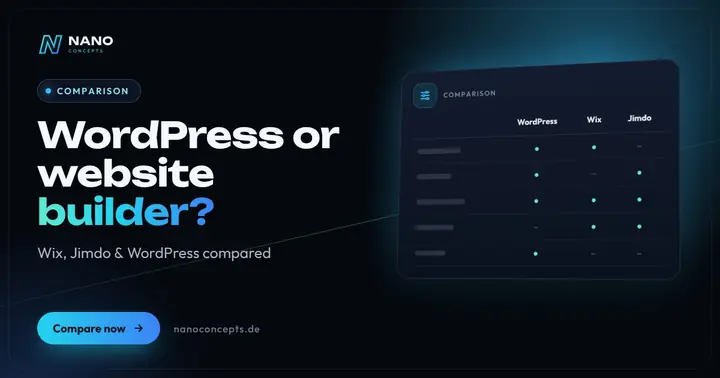
WordPress or a website builder like Wix and Jimdo – which is the better fit?
A website builder like Wix or Jimdo is the right choice if you want to run a small website with only a few pages yourself, quickly and without technical effort – the…
Learn more
Wix or WordPress – which system is the better foundation for your company website?
Wix is the right choice if you want to build and maintain a manageable company website yourself, quickly, and do not want to take responsibility for technology, hosting…
Learn more
WordPress or TYPO3 – which CMS is right for your company?
WordPress is the right choice for most business websites, blogs and stores, up to mid-sized companies (Mittelstand): quick to set up, easy to use and backed by the…
Learn moreNeeds analysis: Depreciate a website?
Answer a few short questions – we usually get back to you within 24 hours with an initial assessment.
Request a project
