
AWS, Azure or Google Cloud – which cloud provider is right for your company?
The three big hyperscalers differ less in their basic technology than in ecosystem, focus areas and licensing models. This comparison shows which provider fits your existing IT and your plans.
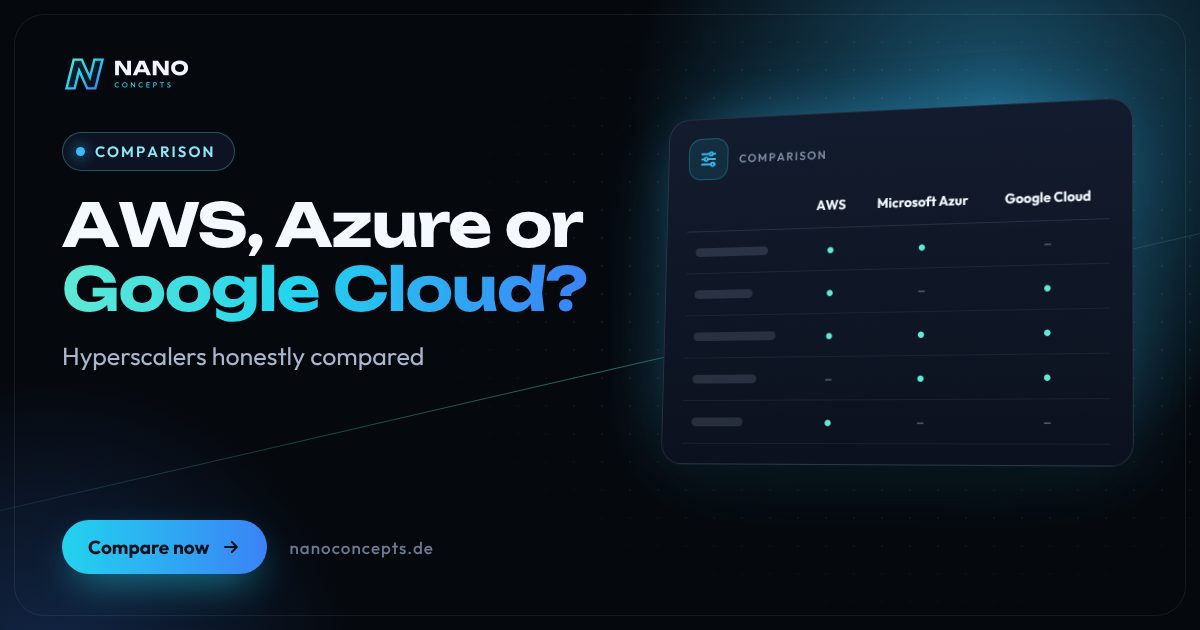
AWS offers the broadest service portfolio and the largest ecosystem and fits almost any scenario – especially platforms and startups that want to scale quickly. Microsoft Azure is the obvious choice for companies that already rely heavily on Microsoft 365, Entra ID, Windows Server or SQL Server. Google Cloud stands out in data analytics, Kubernetes and AI services. All three operate data centers in Germany; for maximum data sovereignty, it is also worth a look at European providers such as Hetzner, IONOS or STACKIT.
Strengths and weaknesses at a glance
AWS
Amazon Web Services is the market leader in cloud computing and offers the most comprehensive portfolio of services – from servers and databases to AI and IoT. In Germany, AWS operates the Frankfurt region, among others.
Strengths
- Broadest range of cloud services and configuration options
- Largest ecosystem of partners, tools and skilled professionals
- Very mature services for serverless, databases and scaling
- Extensive documentation and broad practical experience in the market
Weaknesses
- The sheer number of services and options makes getting started complex
- Cost structure hard to keep track of without monitoring
- Fewer licensing advantages for Microsoft workloads than Azure
Ideal for: Platforms, SaaS products and startups with growth ambitions and a technical team.
Microsoft Azure
Microsoft's cloud platform with tight integration into Microsoft 365, Entra ID and the Windows Server world. In Germany, Microsoft operates Azure regions in Frankfurt and Berlin.
Strengths
- Seamless integration with Microsoft 365, Entra ID and Active Directory
- Licensing advantages for existing Windows Server and SQL Server licenses
- Strong hybrid scenarios in combination with your own data centers
- Access to OpenAI models via Microsoft's AI services
Weaknesses
- Frequent renamings and restructurings make it hard to keep your bearings
- Licensing and contract models sometimes complex
- Fewer benefits for companies without a Microsoft environment
Ideal for: Mid-sized companies and corporations with Microsoft infrastructure that want to extend existing systems into the cloud.
Google Cloud
Google's cloud platform with a focus on data analytics, container technology and AI. In Germany, there are regions in Frankfurt and Berlin.
Strengths
- Very strong data analytics services such as BigQuery
- Mature Kubernetes offering (GKE) – Kubernetes originally comes from Google
- Strong AI platform with Vertex AI and Gemini models
- Clear interface and clean project structure
Weaknesses
- Smaller partner and service provider network among German mid-sized companies (Mittelstand)
- Fewer offerings for classic enterprise IT than AWS and Azure
- Lower adoption, so fewer skilled professionals on the market
Ideal for: Data-driven companies, container platforms and AI projects.
The most important criteria compared side by side
| Criterion | AWS | Microsoft Azure | Google Cloud |
|---|---|---|---|
| Market position | Market leader | Second-largest provider | Third-largest of the big three |
| Service portfolio | Broadest | Very broad, Microsoft focus | Broad, focus on data and AI |
| Regions in Germany | Frankfurt, among others | Frankfurt, Berlin | Frankfurt, Berlin |
| Particular strength | Scaling, serverless, ecosystem | Microsoft integration, hybrid | Data analytics, Kubernetes, AI |
| Identity & office | Connection to third-party systems | Seamless with Entra ID and Microsoft 365 | Integration with Google Workspace |
| AI offering | Amazon Bedrock, SageMaker | OpenAI models via Azure services | Vertex AI, Gemini |
| Getting started | Complex due to variety | Easier in a Microsoft environment | Comparatively clear |
| Skilled professionals & partners | Very many | Very many, strong among mid-sized companies | Fewer, growing |
| Billing | Usage-based, discounts for commitment | Usage-based, licensing advantages | Usage-based, some automatic discounts |
AWS or Azure: what fits your existing IT?
For many companies, the “AWS or Azure” question is decided by existing infrastructure. If you use Microsoft 365, Entra ID and Windows Server systems, Azure benefits you with unified user management, licensing advantages and familiar tools. AWS is more neutral toward your existing software stack and offers the largest range of specialized services – from serverless functions and managed databases to IoT.
In practice, many organizations combine both worlds: Microsoft 365 for the workplace, their own customer platform on AWS. That is technically quite feasible, but it increases complexity in security, networking and cost control. If you're starting fresh, it's worth choosing one primary platform and using multi-cloud only where a service offers real added value.
AWS vs. Google Cloud: data, Kubernetes and AI
Google Cloud has positioned itself as a specialist in data analytics and modern platforms. BigQuery enables analysis of large data volumes without database administration of your own, and the Google Kubernetes Engine is considered particularly mature – Kubernetes was originally developed at Google. With Vertex AI and the Gemini models, Google also offers a strong foundation for AI projects.
AWS counters with services such as Amazon Bedrock for generative AI and a very broad database offering, and scores with the larger ecosystem. For German mid-sized companies (Mittelstand), the availability of partners and skilled professionals also plays a role, and it is greater for AWS and Azure. Google Cloud is therefore the first choice mainly when data and AI applications form the core of your project.
AWS or Azure in Germany: data privacy and European alternatives
All three providers operate data centers in Germany and offer data processing agreements. Since they are US companies, you should still check which data you process there and how the transfer is safeguarded – for instance with a view to the US CLOUD Act. All three are also building out their own offerings for European data sovereignty. This overview does not replace legal advice.
European providers such as Hetzner, IONOS, STACKIT or OVHcloud are a real alternative if you mainly need servers, storage and container environments. In the “AWS vs. Hetzner” comparison, Hetzner gives you simple, easily budgeted infrastructure, but you forgo many managed specialty services. Cloudflare, by contrast, is not a full-fledged replacement, but complements each of the platforms mentioned with a CDN, security features and edge services.
If you already use Microsoft products intensively, Azure is usually the most efficient way into the cloud. If you are building your own platform or a SaaS product with growth plans, AWS offers the broadest foundation. If data analytics, Kubernetes or AI are at the center, Google Cloud is a strong choice. For manageable workloads with a focus on data sovereignty, a European provider is worth considering. Nano Concepts advises vendor-neutrally, plans architecture and costs, and carries out development, migration and operations on the platform you choose.
We implement all options
Databases & Cloud
Data architecture, migration and cloud hosting – high-performing, secure and, on request, in German data centers.
Learn more
Cloud Migration
Assessment, strategy and migration of your servers and applications to the cloud – in German data centers on request.
Learn more
DevOps & CI/CD
Automated tests, builds and deployments – for faster releases and fewer outages in production.
Learn more
Kubernetes Consulting & Operations
Consulting, setup and operation of Kubernetes clusters – with GitOps, monitoring, backups and scheduled version updates.
Learn moreFrequently asked questions
Neither is better across the board. Azure plays to its strengths in Microsoft-oriented environments, while AWS offers the broadest range of services and the largest ecosystem. What matters are your existing IT, your team's know-how and the services you need.
Yes. AWS operates a region in Frankfurt, among others, Microsoft Azure has regions in Frankfurt and Berlin, and Google Cloud likewise in Frankfurt and Berlin. This lets you store data in Germany; the legal assessment of the providers as US companies remains unaffected.
AWS has been the largest provider of cloud infrastructure for years, followed by Microsoft Azure and Google Cloud. Market share, however, says little about which provider fits your project. Ecosystem, existing licenses, available skilled professionals and specific services are the more important criteria.
For many workloads, yes: if you mainly need virtual or dedicated servers and storage, Hetzner gives you simple, easily budgeted infrastructure from a German provider. AWS offers managed specialty services for AI, serverless or global scaling on a far larger scale. A combination is often sensible, with core systems running at a European provider.
The costs depend on the number and complexity of the applications, data volumes, security requirements and the desired degree of automation. Our packages serve as a guide for planning, migration and development: Starter from €2,500, Professional from €8,000 and Enterprise priced individually. The cloud provider's usage-based fees come on top; the exact quote follows after the free initial consultation.
More comparisons & guides
Cloud, SaaS or on-premise – where should your software run?
SaaS fits if mature off-the-shelf software exists for your process and you don't want any operating effort.
Learn more
How much does cloud hosting cost – and what determines the price?
The cost of cloud hosting depends on computing power, memory, storage, data traffic, availability, backups, location and the level of support.
Learn more
How much does a website cost per month – and per year?
The monthly cost of a website is made up of the domain, hosting, email mailboxes, possible licenses for themes, plugins, or tools, and maintenance and updates; an SSL…
Learn more
What do you need for your own website?
For your own website you need five building blocks: a domain as the address, hosting as the storage location, the website itself – built with a CMS, a site builder or…
Learn more
WordPress or a website builder like Wix and Jimdo – which is the better fit?
A website builder like Wix or Jimdo is the right choice if you want to run a small website with only a few pages yourself, quickly and without technical effort – the…
Learn more
n8n, Make or Zapier – which automation tool is right for you?
Zapier is the easiest way to get started, with one of the largest catalogs of ready-made app connections, but it becomes expensive at high volumes because every…
Learn moreNeeds analysis: AWS, Azure or Google Cloud?
Answer a few short questions – we usually get back to you within 24 hours with an initial assessment.
Request a project
