
What does digitalization mean for a company?
In a company, digitalization means converting analog information and processes into digital ones and simplifying or automating them with software. It ranges from scanning paper to digital order processing to new, data-driven business models.
Digitalization: term and distinctions
The term is used in different ways. Technically, three levels can be distinguished: digitization means the pure conversion of analog data into digital, such as paper into PDF. Digitalization in the narrower sense improves processes with digital tools, for example digital order processing. Digital transformation changes business models, for instance through platforms or new offerings.
For SMEs, the second level is usually decisive: making existing processes faster, less error-prone and more transparent. The point is not to introduce as many tools as possible but to reduce effort, secure quality and serve customers better. Technology is a means to an end.
How digitalization succeeds
The starting point is the processes, not the software. First, describe how an order arises today, who records what and when, and where time is lost. Only then is it decided which solution fits. Anyone who digitalizes a bad process ends up with a bad digital process.
A step-by-step approach has proven its worth: set goals, choose an area with high benefit, start a pilot, evaluate experience, then expand. Employees are involved early, because acceptance decides success. Funding options from the federal government and the states change constantly and should be checked for current terms before the project starts.
Real-world example: a trade business replaces paper slips
A plumbing business writes orders on slips of paper, copies timesheets in the evening and issues invoices weeks late. With digital order management, technicians record working time, materials and photos directly on the smartphone. The office creates the invoice from that on the same day and hands it to accounting.
The business gets paid sooner, forgets less material and can document change orders. Questions from customers about invoice items can also be settled with photos and times. The switch works because it starts small: first mobile time tracking, then job photos, finally invoicing. Each stage brings an immediate, noticeable benefit for those involved, so employees experience the change as relief rather than extra work.
Obligations, mistakes and implementation
Some requirements make digitalization mandatory: since January 1, 2025, companies in Germany must be able to receive e-invoices, and the obligation to issue them applies in stages from 2027 and 2028 respectively. Since June 28, 2025, the German Accessibility Strengthening Act (BFSG) has also applied to certain digital products and services.
Nano Concepts supports digitalization projects from analysis through prototypes to implementation of custom software, interfaces and automation. We help you pick, from many possible measures, the ones with the greatest benefit in your business, and implement them in manageable steps.
- Clarify processes before technology
- Begin with a manageable pilot project
- Involve and train employees from the start
- Avoid isolated solutions and plan interfaces
- Measure benefit, for example in time saved
Frequently asked questions about Digitalization
Digitalization improves existing processes with digital tools. Digital transformation goes further and fundamentally changes the business model, offering or customer relationship, for example through a platform or new data-based services. Digitalizing processes is usually the foundation for it.
With an honest inventory: where do duplicate work, errors and waiting times arise? Choose an area with high benefit and manageable effort, such as quotes, time tracking or incoming invoices. A successful pilot project builds trust for the next steps.
Examples are e-invoicing between businesses, the GoBD requirements for digital bookkeeping, the GDPR and the BFSG for certain digital offerings. Which obligations apply to you depends on your industry and business model and should be checked case by case.
There are programs from the federal government and the states whose terms, deadlines and funding amounts change frequently. Before the project starts, inform yourself with the responsible body, such as your chamber or state development bank, and apply in good time before placing orders.
Matching services
Digital Transformation Consulting
Analyze processes, set priorities, create a roadmap – digital transformation consulting for SMEs with implementation in mind.
Learn more
Process Automation
Recurring tasks run automatically – less manual work, fewer errors, more time for your business.
Learn more
Software Modernization
Take over, secure and gradually migrate legacy systems to modern technology – without business interruption or data loss.
Learn more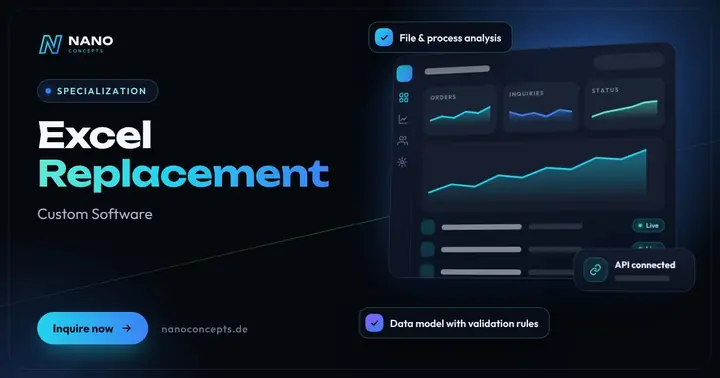
Excel Replacement
Grown Excel and Access files become a secure multi-user application with permissions, history and reporting.
Learn moreRelated terms
Relevant for these industries
Related magazine articles
B2B Marketing Automation and Lead Nurturing: From Click to Sales
Marketing automation only works when the processes are clear beforehand. Here is how to build lead nurturing with scoring, journeys and a CRM handover while respecting consent and data protection.
Read more
Automating Business Processes: 5 Workflows to Start With
Sorting inquiries, coordinating appointments, retyping quotes: five workflows that can be automated in almost every company – with a prioritization guide, a practical example and the typical mistakes.
Read more
B2B Social Selling: How Thought Leadership Strengthens Sales
Decision-makers research for a long time before they speak to sales. Here is how to build trust with B2B social selling, align marketing and sales and make the impact measurable in the CRM.
Read more
